'%3e%3cpath%20d='M923.21,488.13c-3.16-7.79-8-17.56-17.57-23.98-7.1-4.71-15.4-7.26-26.92-8.25h-.1c-10.32-.4-20.27,1.96-29.91,4.23-4.24,1-8.63,2.04-12.86,2.79-.6,.09-1.21,.19-1.82,.29-6.34,1.01-12.33,1.96-16.47-2.28-4.53-4.5-7.47-10.23-10.59-16.29-.45-.87-.9-1.74-1.35-2.61-.72-1.39-1.44-2.8-2.16-4.23-4.16-8.22-8.45-16.73-15.65-23.28-18.43-15.29-34.28-18.48-54.69-10.97-22.67,8.36-37.54,33.4-42.24,54.59-2.87,15.38-2.15,32.19,2.13,49.98l.45,1.85,7.53-1-.13-1.98c-.85-12.5-1.5-25.81,.63-39.05,.24-1.82,.61-3.79,.97-5.69,.12-.62,.23-1.23,.34-1.83,4.21-17.82,16.55-38.81,34.65-45.55,15.72-5.72,26.37-3.71,40.67,7.66,6.3,4.96,10.7,13.81,15.36,23.17,5.29,10.63,10.77,21.63,19.58,27.24,9.41,5.91,24.21,2.42,38.51-.96,10.72-2.53,21.81-5.15,29.92-3.62l.12,.02c12.7,1.61,20.97,6.61,26.03,15.76,2.9,5.15,4.68,9.37,5.58,13.21,2.52,12.29-.58,26.58-9.2,42.48-4.39,8.11-10.97,15.51-20.12,22.64-4.9,3.85-10.66,7.32-16.23,10.67-3.81,2.29-7.75,4.66-11.4,7.15-20.44,14.22-31.7,35.12-40.01,53.69l3.67,2.08c1.54-2.21,3.06-4.45,4.58-6.68,4.48-6.59,9.11-13.41,14.4-19.52,8.3-9.69,17.35-17.36,26.89-22.78,1.41-.81,4.32-2.51,6.88-4.01,1.58-.92,3.03-1.77,3.91-2.29,14.97-8.65,25.81-17.81,33.19-28.03,6.62-9.57,11.72-20.52,14.35-30.83,3.21-12.58,2.9-23.94-.94-33.77Z'/%3e%3cpath%20d='M214.5,531.7c6.65,3.39,11.75,8.22,15.29,14.51,3.54,6.29,5.32,13.7,5.32,22.22s-1.77,15.91-5.32,22.16c-3.54,6.25-8.64,11.03-15.29,14.33-6.65,3.31-14.51,4.96-23.59,4.96h-25.92v-83.27h25.92c9.08,0,16.94,1.69,23.59,5.08Zm1.02,60.69c5.65-5.69,8.48-13.68,8.48-23.95s-2.85-18.44-8.54-24.25c-5.7-5.81-13.88-8.72-24.55-8.72h-15.05v65.46h15.05c10.75,0,18.95-2.85,24.61-8.54Z'/%3e%3cpath%20d='M260.31,535.46v27.83h30.34v8.96h-30.34v28.67h33.93v8.96h-44.8v-83.38h44.8v8.96h-33.93Z'/%3e%3cpath%20d='M376.19,609.89h-10.87l-43.72-66.3v66.3h-10.87v-83.38h10.87l43.72,66.18v-66.18h10.87v83.38Z'/%3e%3cpath%20d='M445.96,526.62v8.84h-22.7v74.42h-10.87v-74.42h-22.82v-8.84h56.39Z'/%3e%3cpath%20d='M508.55,591.37h-36.32l-6.69,18.52h-11.47l30.1-82.79h12.54l29.98,82.79h-11.47l-6.69-18.52Zm-3.11-8.84l-15.05-42.05-15.05,42.05h30.1Z'/%3e%3cpath%20d='M608.66,526.62l-31.42,83.27h-12.54l-31.42-83.27h11.59l26.16,71.8,26.16-71.8h11.47Z'/%3e%3cpath%20d='M631.48,526.62v83.27h-10.87v-83.27h10.87Z'/%3e%3cpath%20d='M718.8,526.62l-31.42,83.27h-12.54l-31.42-83.27h11.59l26.16,71.8,26.16-71.8h11.47Z'/%3e%3cpath%20d='M747.35,605.29c-6.37-3.62-11.41-8.68-15.11-15.17-3.7-6.49-5.55-13.8-5.55-21.92s1.85-15.43,5.55-21.92c3.7-6.49,8.74-11.55,15.11-15.17,6.37-3.62,13.42-5.44,21.15-5.44s14.89,1.81,21.26,5.44c6.37,3.62,11.39,8.66,15.05,15.11,3.66,6.45,5.5,13.78,5.5,21.98s-1.83,15.53-5.5,21.98c-3.66,6.45-8.68,11.49-15.05,15.11-6.37,3.62-13.46,5.44-21.26,5.44s-14.77-1.81-21.15-5.44Zm36.85-8.06c4.66-2.71,8.32-6.57,10.99-11.59,2.67-5.02,4-10.83,4-17.44s-1.33-12.52-4-17.5c-2.67-4.98-6.31-8.82-10.93-11.53-4.62-2.71-9.88-4.06-15.77-4.06s-11.15,1.35-15.77,4.06c-4.62,2.71-8.26,6.55-10.93,11.53-2.67,4.98-4,10.81-4,17.5s1.33,12.42,4,17.44c2.67,5.02,6.33,8.88,10.99,11.59,4.66,2.71,9.89,4.06,15.71,4.06s11.05-1.35,15.71-4.06Z'/%3e%3c/g%3e%3c/svg%3e)

Written by Sedef Özdemir · Content Specialist

Medically reviewed by Dr. Mine Helvacıoğlu Özkardeş, Prosthodontist
14+ years of experience in smile design, veneers, and implant-supported restorations.
Last reviewed: 4 August 2026
What Is Teeth Whitening?
Teeth whitening is a cosmetic treatment that uses bleaching agents to reduce the appearance of staining and discolouration, lightening the natural colour of your teeth. It can be carried out in a dental clinic under professional supervision, which generally allows for higher-strength, more controlled treatment than over-the-counter or at-home options.
What Smile Concerns Can Teeth Whitening Improve?
Whitening addresses surface and some deeper staining caused by diet, particularly coffee, tea, and red wine, smoking, ageing, and certain medications taken during tooth development. It brightens your natural teeth without changing their shape or position, which is why it’s often the starting point for patients considering a wider smile makeover.
Types of Teeth Whitening
- In-clinic professional whitening. Higher-concentration bleaching agents applied under dental supervision, often activated with light, generally giving the fastest, most dramatic results in a single visit.
- Dentist-supplied take-home kits. Custom-fitted trays and professional-strength gel used at home over a set period, offering a gradual result with dental oversight.
- Over-the-counter products. Lower-strength whitening strips or toothpastes, generally producing more modest results over a longer period, without professional supervision.
Professional vs. At-Home Teeth Whitening
Professional whitening, whether done in-clinic or with a dentist-supplied take-home kit, uses stronger bleaching agents under proper supervision, which generally means faster, more even, and longer-lasting results than unsupervised over-the-counter products. It also means a dentist checks that whitening is appropriate for your teeth beforehand, rather than treating discolouration that might actually need a different approach, such as bonding or veneers for internal staining that bleaching doesn’t reach.
Who Is a Suitable Candidate?
Whitening is generally suitable for patients with healthy teeth and gums whose discolouration is caused by surface staining, diet, smoking, or ageing. It’s not suitable for every type of discolouration, some internal staining, for example from certain medications taken in childhood, doesn’t respond to bleaching, which your dentist can assess.
This section is general information. Individual candidacy can only be confirmed after a clinical examination, medical history review, and diagnostic imaging by a qualified dentist.
When May Teeth Whitening Not Be Suitable?
If discolouration is caused by an internal factor that bleaching doesn’t reach, or if a tooth already has a crown, veneer, or filling on its visible surface (since these materials don’t change colour with bleaching), whitening alone may not achieve an even result, and bonding or veneers may be discussed instead. Active decay or gum disease is generally treated before whitening as well.
Your Smile Consultation and Assessment
Share a photo of your smile and what you’d like to improve through our contact form or WhatsApp, and our team follows up with an initial assessment. Your dentist confirms in person that whitening is the right approach and identifies your current shade before treatment.
How Is Your Smile Designed?
Unlike veneers or crowns, whitening doesn’t involve reshaping your teeth, so “design” here mainly means agreeing on your target shade, how many shades lighter you’re aiming for, based on your current colour and what will look natural against your gums, lips, and skin tone.
Choosing the Right Tooth Shape and Proportions
Whitening doesn’t change tooth shape or proportions at all, it only affects colour. If shape or proportion is also a concern, that’s addressed with a separate treatment, such as bonding or veneers, sometimes planned alongside whitening as part of a broader smile plan.
Choosing the Right Tooth Shade
Your target shade is agreed against a shade guide before treatment starts, informed by your current colour and how bright a result you’re looking for. Reaching your target shade also depends on the cause of your discolouration, since some staining responds better to bleaching than others.
Natural-Looking vs. Bright Smile Results
Whitening results can be tailored to your preference: a moderate lift for a natural, refreshed look, or a more dramatic change for a noticeably brighter smile. Going overly bright relative to the whites of your eyes or skin tone can look unnatural, so your dentist can advise on a shade that suits you specifically.
Teeth Whitening Procedure: Step by Step
- Assessment. Examination to confirm your teeth and gums are suitable for whitening and to identify the likely cause of discolouration.
- Preparation. Protective measures are used to shield your gums and soft tissue from the bleaching gel.
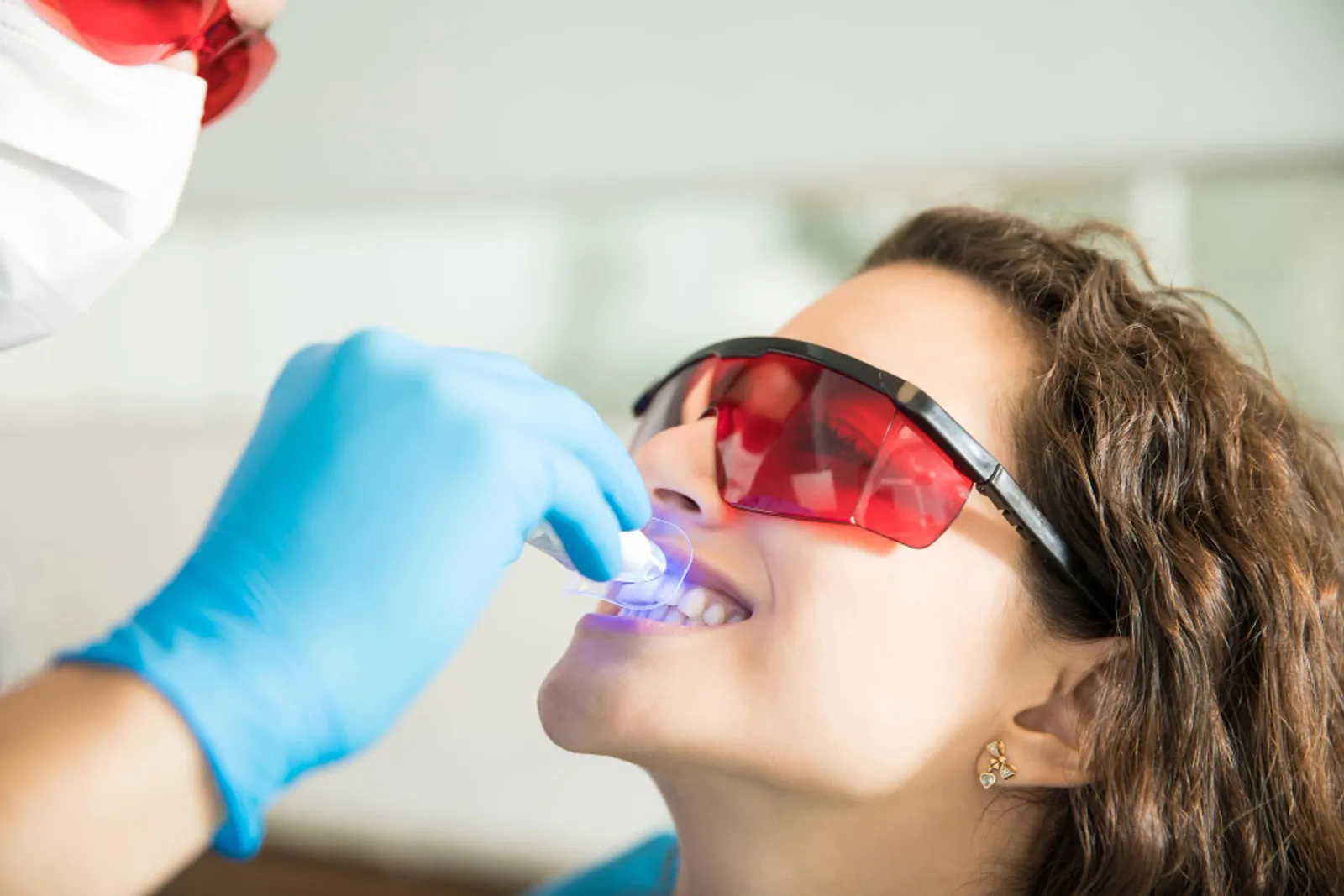
- Application. A bleaching agent is applied and, depending on the method, may be activated with a special light.
- Aftercare guidance. Advice is given on diet and habits that can affect how long your results last.
How Much Natural Tooth Is Prepared?
None. Whitening doesn’t involve removing or reshaping any tooth structure, it works by breaking down staining compounds within the enamel and just beneath its surface.
Is Teeth Whitening Reversible?
Whitening doesn’t permanently alter your teeth the way veneers or crowns do, but it also isn’t something you “reverse” so much as something that naturally fades over months to a couple of years as new staining accumulates. There’s no tooth structure to restore afterward, since none was removed in the first place.
Will You Need Temporary Restorations?
No. Whitening is a single, complete treatment with no temporary stage involved.
How Many Teeth May Need Treatment?
Most patients whiten all their visible teeth together for an even result, typically the top and bottom teeth shown when smiling. Whitening individual teeth in isolation can create a mismatch with untreated neighbouring teeth, so your dentist will generally recommend treating the full visible set together.
How Long Does Teeth Whitening Take?
A single in-clinic session typically takes 30 to 60 minutes. Take-home kits work more gradually, generally worn for a set period each day over one to two weeks to reach your target shade.
How Many Appointments Are Required?
In-clinic whitening is usually completed in a single appointment. If you’re using a dentist-supplied take-home kit, one visit is needed to have trays made, with the whitening itself done at home afterward.
How Long Should You Stay in Istanbul?
In-clinic whitening can be completed within a single day, making it easy to combine with a check-up or other treatment during a short trip. If you’re taking home a kit, that part of the process continues after you’ve returned home.
Recovery and Sensitivity
There’s no recovery period after whitening. Mild tooth sensitivity or slight gum irritation for a day or two is common, particularly with higher-strength professional treatment, and generally settles on its own.
Eating and Drinking After Treatment
For the first 24 to 48 hours after whitening, it’s best to avoid strongly coloured foods and drinks, coffee, tea, red wine, and dark sauces, since your teeth are more porous and prone to picking up new staining immediately after treatment.
How to Care for Your New Smile
Brush and floss as usual, and be mindful of staining foods and drinks, or use a straw for dark beverages, to help your results last longer. Periodic touch-up treatment, whether a single in-clinic session or a short course of take-home trays, helps maintain your shade over time.
Benefits of Teeth Whitening
Whitening is one of the fastest, least invasive ways to noticeably improve your smile, with no tooth structure removed and no recovery period. It’s often a good starting point before considering more involved cosmetic treatment, since brightening your natural teeth alone is sometimes enough to achieve your goal.
Risks and Limitations
The main risks are temporary tooth sensitivity and mild gum irritation, both generally short-lived. Whitening doesn’t change existing crowns, veneers, or fillings, which can leave them looking mismatched against newly whitened natural teeth, something your dentist will flag before treatment if it applies to you.
How Long Do the Results Last?
Results typically last from several months up to around two years, depending on your diet, smoking habits, and oral hygiene. Touch-up sessions, whether in-clinic or a short course of take-home trays, are generally recommended periodically to maintain your shade.
What Can Stain or Damage the Results?
Coffee, tea, red wine, dark sauces, and smoking are the most common causes of new staining after whitening. Poor oral hygiene also allows staining to build up faster on the tooth surface.
How to Prevent Staining
Rinsing your mouth with water after coloured foods or drinks, using a straw for dark beverages, and keeping up with regular brushing and professional cleanings all help slow new staining after whitening. If smoking is a factor, cutting back is one of the most effective ways to help your results last.
Alternatives to Teeth Whitening
- Whitening vs. veneers. If your teeth are well-shaped and colour is your only concern, whitening alone may achieve your goal; if shape, gaps, or chips are also a factor, veneers address more at once.
- Whitening vs. bonding. For a stained tooth alongside a chip or small gap, bonding can address both colour and shape in one step, though it doesn’t whiten surrounding natural teeth.
- No treatment. Staining generally continues to build up gradually over time without intervention, so whitening (or avoiding staining habits) is the main way to reverse it.
Teeth Whitening Compared With Other Cosmetic Options
Compared with veneers, bonding, or a full Hollywood Smile plan, whitening is the fastest, least expensive, and least invasive option, but it only changes colour, not shape, gaps, or alignment, and its results fade over time rather than being long-term like ceramic restorations. It’s often used as a first step or combined with other treatments as part of a broader plan.
Materials Used for Teeth Whitening
Whitening uses a bleaching gel, most commonly containing hydrogen peroxide or carbamide peroxide, at a concentration appropriate to whether it’s applied in-clinic under supervision or as a lower-strength take-home product.
Material Comparison
In-clinic whitening gel is generally higher concentration for faster, more controlled results in a single visit. Take-home kit gel is lower concentration, applied over a longer period, and over-the-counter strips or gels are typically the mildest, giving the most gradual and limited results of the three.
Teeth Whitening Cost at Dentavivo
At Dentavivo, teeth whitening starts from €250. The exact price depends on the method used and whether it’s combined with other treatment during your visit.
We don’t publish a single fixed price for every case, since starting shade and goals vary. Share some details about your case through our contact form or WhatsApp, and our team will follow up with a clear, personalized quote.
What Is Included in the Price?
Your quote covers the assessment, protective preparation, and the whitening application itself, along with aftercare guidance on maintaining your results.
What Factors Affect the Final Cost?
The method, in-clinic versus a take-home kit, is the main factor, along with whether whitening is combined with other treatment, such as a cleaning, during the same visit.
What Is Included for International Patients?
Once you share your case with us, our team reviews it and follows up with a personalised treatment plan and a free quote, so there are no surprises once you arrive. We stay in touch by WhatsApp and email throughout, and whitening can often be combined with a check-up or cleaning in the same short visit.
Before and After Teeth Whitening
Results vary depending on your starting shade and the cause of discolouration, which is exactly why we publish real photos rather than describe them. You can see genuine, unedited whitening cases from Dentavivo patients in our Before & After gallery.
Real Smile Makeover Case Studies
Our Before & After gallery also includes fuller smile makeover results where whitening was combined with veneers or bonding, so you can see the kind of comprehensive results our cosmetic dentistry team achieves.
Meet the Cosmetic Dentistry Team
Cosmetic treatment at Dentavivo is medically reviewed by Dr. Mine Helvacıoğlu Özkardeş, a prosthodontist with 14+ years of experience in smile design. You can read her full background, education, and publications on her profile page.
Why Choose Dentavivo for Teeth Whitening?
Dentavivo has been treating international patients in Istanbul for over a decade, and whitening can often be completed in the same visit as your consultation or a check-up, making it easy to fit into a short trip. Every case is assessed individually, and you can see genuine, unedited results from real patients rather than stock photography.
Treatment Warranty and Conditions
Whitening results are expected to fade gradually over time rather than being a permanent, warrantied outcome; your dentist will explain what to expect and how to maintain your shade as part of your treatment plan.
Medical Review and References
This page was last reviewed on 4 August 2026 by Dr. Mine Helvacıoğlu Özkardeş. Where possible, it links to independent sources rather than asking you to take our word for it:
- American Dental Association (ADA): the U.S. professional association for dentists, publishing evidence-based clinical guidance and patient resources.
- National Institute of Dental and Craniofacial Research (NIDCR): part of the U.S. National Institutes of Health, publishing independent research and patient education on oral health.
Content on this page is general dental information reviewed by Dentavivo's dental team. It is not a substitute for individual medical advice. Treatment plans, suitability, and costs are confirmed only after a personal consultation and clinical examination.
Frequently Asked Questions
How much does teeth whitening cost?
At Dentavivo, teeth whitening starts from €250, though the exact price depends on the method used and whether it's combined with other treatment during your visit. Share your details with us for a free, personalised quote.
Is teeth whitening safe?
Yes, when carried out or supervised by a dentist. Your gums and soft tissue are protected during treatment, and a dentist first confirms your teeth are suitable for whitening. Temporary sensitivity is the most common side effect, and it's generally short-lived.
Does teeth whitening damage tooth enamel?
Professional whitening, used as directed, is not considered damaging to enamel. It works by breaking down staining compounds within the enamel rather than eroding the tooth structure itself, though some people experience temporary sensitivity as it takes effect.
How does professional whitening differ from at-home kits and strips?
Professional, dentist-supervised whitening typically uses higher-concentration bleaching agents under controlled conditions, which generally gives faster, more even, and longer-lasting results than at-home kits or strips, which use lower concentrations over a longer period and aren't monitored by a dentist. Suitability and appropriate strength should be assessed by a dentist regardless of method.
Are whitening results permanent?
No, whitening results aren't permanent. Diet, smoking, and oral hygiene habits affect how long results last, and touch-up treatment is generally recommended over time to maintain your shade.
How long does teeth whitening take?
A single in-clinic session typically takes 30 to 60 minutes and is completed in one visit. How many shades lighter you go depends on your starting colour and the cause of any discolouration.
Does teeth whitening actually work?
For the great majority of patients with surface staining from diet, smoking, or ageing, yes, whitening produces a visibly lighter result. Some types of internal staining respond less well to bleaching, which is why a dentist's assessment beforehand matters.
Does teeth whitening have side effects?
Temporary tooth sensitivity and mild gum irritation are the most common side effects, generally settling within a day or two after treatment. Using a professional whitening service under dental supervision, rather than an unsupervised product, reduces these risks.
Does dental insurance cover teeth whitening?
Whitening is generally considered a cosmetic treatment, so most dental insurance plans offer little to no coverage for it. We recommend checking with your own insurer, though many patients find Dentavivo's pricing affordable even without coverage.
How long do professional whitening results last?
Results typically last from several months up to around two years, depending on your diet, smoking habits, and oral hygiene. Periodic touch-up sessions, whether in-clinic or a short course of take-home trays, help maintain your shade over time.
Related Treatments
Dental Veneers
Thin, custom-made shells bonded to the front of your teeth to reshape and brighten your smile.
Hollywood Smile
A full smile makeover combining several cosmetic treatments, personalised to your face and goals.
Dental Bonding
A minimally invasive way to repair chips, gaps, or discolouration in a single visit.
This page provides general information and does not constitute individual medical advice. Treatment suitability, plans, and costs can only be confirmed after a personal consultation and clinical examination with a qualified dentist. Individual results vary.